Saturday, June 16, 2018

The Newport scene

We spent Saturday morning in Newport at the SVF Foundation's farm, which houses the Smithsonian and SVF Biodiversity Project.  The project's mission is to prevent the extinction of as many livestock breeds as possible.  They use liquid nitrogen to cryogenically preserve the semen and embryos of rare and endangered breeds so they would be able to bring them back if that ever became necessary.  They are open to the public on only one day each year, and we happened to visit Newport at just the right time.

There were demonstrations of the cryogenic freezing process, and several endangered breeds of cattle, pigs, goats, and plants were displayed.  Lots of families came out, and the event was very well organized.

We also visited the Newport Car Museum.  Unlike many such exhibits which feature vintage automobiles from the early years, this one displays the most impressive examples of the past fifty years or so - beautiful European models from Ferrari, BMC, Lamborghini, Porsche, Jaguar, and Mercedes Benz, as well as large galleries of Shelby/Ford cars, fin cars, muscle cars, and Corvettes.  Some of my American favorites were Shelby Cobras, Corvette Stingrays, and a Dodge Viper.  But for me, the truly magnificent sculptural examples of the automotive art have been European - Jaguar XKE, Turbo Porsche, Mecedes Benz 300SL, various Ferraris, and many others on display there.  Certainly the most exotic automobiles ever produced, in my opinion, were made by Lamborghini, including the sexiest car of all time, the Lamborghini Countach.  If I ever win the lottery ...


Of course at my age, before plunking the money down, I'd have to make sure I was able to get into and especially out of the driver's seat.  Without assistance.

We had time for one more mansion visit, this time to the Chateau-sur-Mer, the family home of William Wetmore, who made his fortune in the China trade.  It was built in 1852, much earlier than the first two we toured.  At one time it was the largest home on mansion row, but the later palaces were much more colossal.  As it turned out, this one was our personal favorite - more intimate, less intimidating, with lots of beautiful woodworking details.  You could almost imagine living there.


And since this mansion was less well attended than the other two, we had an actual tour guide instead of earphone descriptions and instructions.


Newport is very active in the summer, very quiet in the winter.  We are here just before all the schools are out, so I assume it will get more crowded in the weeks coming up.  At present the traffic flow is rather slow at times, but not horrible.

The historic Newport Jazz Festival is scheduled for August, the Newport Folk Festival for July.  The Newport-to-Bermuda sailboat race began this weekend.  The people who live in Newport are almost universally crazy about the place.  They say that in the winter many of the restaurants and shops close, but even then it's a beautiful place to call home.

We like Newport quite a lot and attended a couple of open houses to get an idea of what prices are like and whether there might be a neighborhood meeting our needs.  One of the homes we walked through was very attractive, close to the waterfront and to downtown, with a list price that was fairly high but less expensive than it would be in Santa Cruz.  I think Nancy is slightly less enthusiastic than I am about Newport, but I'm going to add it to our list of possibles.

Friday, June 15, 2018

The Mansions of Newport, Rhode Island

America's "gilded age" - the late 19th century - was a time when capitalism was unregulated and robber barons and captains of industry accumulated staggering, unprecedented wealth.  The beautiful seaside estates of Newport, Rhode Island became the site of a competition in mansion building among some of those filthy rich families.

We took a trolley tour that carried us through Newport's pretty downtown and then along mansion row - Bellevue Avenue.  The number of grand houses we passed was mind-blowing.  Many of them were designed in the style of the great French chateaux.  There sure were a bunch of incredibly wealthy folks back then.

Our tour guide told us that during the great depression of 1929 many of the mansion-builder families lost their fortunes and were no longer able to afford the upkeep of their palaces.  Eventually many of the mansions went on to serve other functions.  For example, a number of them, like the one below, were consolidated into Salve Regina University, a Catholic liberal arts institution.  What an amazing campus that would be for getting an education.


Some of the most impressive of these mansions have become public museums.  The one most commonly recommended for touring is The Breakers, built in 1895 by the family of Cornelius Vanderbilt, the railroad magnate.


It was of course very impressive, with high ceilings, grand staircases, lots of artwork, and the best technology available back then.  You could imagine the parties that the Vanderbilts threw.  However, I'm not sure how comfortable it would have been for day-to-day living. Maybe that's envy talking.


We also toured The Elms, built in 1901 by coal magnate Edward Berwind.  A modest little cottage.


That evening we had dinner at Bouchard, a well-reviewed restaurant in downtown Newport.  It is a rarity these days - a truly traditional French restaurant, with much less experimentation than most high-end restaurants feel is necessary to separate them from their competitors.  But delicious and beautifully presented, it was one of the great meals of our trip.


I'm a fan of this Newport town.  We're going to check out open houses on Saturday.

Monday, June 11, 2018

Northampton, Massachusetts

Seven years ago we visited the Major League Baseball Hall of Fame in Cooperstown, New York.  It was a wonderful facility that gave a sense of the history of that great sport.  Every inductee into the Hall of Fame had a bronze bust with a list of his accomplishments.  It was a moving testament to the national pastime (even though football has actually eclipsed baseball as our national obsession).

So it was quite a thrill when, on the way to our next campground, we stopped for lunch in Springfield, Massachusetts and saw across the street an impressive building housing the Naismith Memorial Basketball Hall of Fame.

The timing was amazing in that it was just the night before when the Golden State Warriors, based in Oakland, my favorite sports team, had won the 2018 NBA championship.  That's their third championship in four years - a remarkable accomplishment - and Nancy and I are both huge Warriors fans.  I literally watch every one of their games during the.season on our motorhome's TV (thanks to the DirecTV dish on our roof).  And of course the playoffs, which go on for almost two months, are even more must-see events for me.

To illustrate the extent of my obsession, we've been in the eastern time zone for several months now, and Warriors regular season home games begin at 7:30 PM Pacific time; that's 10:30 PM Eastern time.  So the games end well after 1 PM, and I even watch the post-game shows.  Plays havoc with one's sleeping habits.

Unfortunately, the Basketball Hall of Fame was something of a disappointment.  The standard set by the Cooperstown Baseball Hall of Fame was not even close to being met.  Naturally there were some historical details about the invention of the game by James Naismith, and photos and descriptions of the early years of the sport, the college game, and the NBA.  But there were no busts of the Hall of Fame inductees, and I couldn't find anything about the recent exploits of the Warriors.  In Cooperstown there had been a whole section on the recent World Series winners.

There were just a few statues of basketball stars.  This is Larry Bird, a great player of thirty years ago.


The most popular section of the Hall of Fame building was a large basketball court in the center, where kids could shoot some hoops.


Our current campground is next door to Northampton, Massachusetts, which is the hub for four colleges, including Smith and Amherst.  Northampton's downtown reminds us somewhat of the Santa Cruz Pacific Garden Mall.  It's a little hippy-dippy, a college town, with panhandlers, crystal stores, massage therapists, and psychic counselors.  But it doesn't have anything like the beauty and class of Santa Cruz, so we're not tempted.

Northampton is the site of the Calvin Coolidge Presidential Library.  Unlike the official presidential libraries we've visited, this one is literally in a public library building.  It occupies only a large room on the second floor, where Coolidge's papers have been collected and stored ever since his presidency.

We learned a bit of history in talking with a docent there.  Coolidge, a Massachusetts politician, was vice-president under Warren Harding and assumed the presidency when Harding died in 1923 and was re-elected in 1924, serving until 1929.  He seems to have been a decent person and an okay president, balancing the budget in every year of his term in office.  However, the 1929 depression began shortly after he left office, so his legacy is not unblemished.

None of the NBA Hall of Famers have busts to honor them, but Calvin Coolidge does.


Friday, June 8, 2018

Connecticut

New England consists of six states in the northeastern corner of the United States - Connecticut, Massachusetts, New Hampshire, Rhode Island, Vermont, and Maine.  Well, we've reached New England. 

Our campground is in Moodus, Connecticut, and in fact, this region is chock full of picturesque towns, both beside the Connecticut River and along the Atlantic coast.  A few miles away from our RV park is the village of East Haddam, and one night we attended The Will Rogers Follies there at the Goodspeed Opera House, which was built in 1876, went into disrepair, was restored in 1959, and since 1963 has been the site of highly professional musical productions, mostly featuring actors, singers, and dancers from the Broadway stage.


It's an adorable little theater, with a grand stairway entrance.


Will Rogers was a cowboy humorist, partly of Cherokee extraction, who became a star of Broadway, radio, and the movies.  His most famous line was, "I never met a man I didn't like."  The Will Rogers Follies, a story of his life and times, was a hit on Broadway in 1991.  This revival was beautifully done - hard to imagine a better version - with high-quality singing and dancing.  It was a lovely evening.

Also in East Haddam is the Gillette Castle State Park.  William Gillette was a famous stage actor from about 1880 to 1930 whose most significant accomplishment from our point of view is that he established in the mind of America the current image of Sherlock Holmes, with deerstalker cap and curved pipe.

In 1914 he began construction of a grand home in East Haddam.  Naturally, I'm interested in any obsessive who designs and builds his own castle.  We weren't impressed by the exterior of the structure ...


.. but the interior was quite lovely, with some fascinating woodworking details.


One day we drove to Mystic, Connecticut, an attractive town on the coast.  After a nice lunch overlooking the sea, we toured the Mystic Seaport Museum, an extensive recreation of a whalers' village.  We went aboard the Charles W. Morgan, built in 1841, the only surviving whalers' ship of that era, and got an impression of what life was like onboard.


Just down the road from our campground is the schoolhouse in which Nathan Hale, a hero of the Revolutionary War, taught, after attending Yale at age 14.  Nathan Hale was convicted of espionage by the British and executed at age 18, and he's best remembered for his last words: "I regret that I have but one life to give for my country."  Two nice ladies filled us in on his history.


Today we visited another couple of cute little towns in the area - Old Saybrook and Essex - and had lunch at the restaurant in the Griswold Inn in Essex, a beautiful old hotel Nancy and my mother and I had stayed in on a previous trip many years ago.  The restaurant is an incredible room, maybe my favorite interior ever, with wonderful framed drawings and paintings of sailing ships covering all the walls.


I'm a big fan of the area.  It's full of important historical details.  The villages and houses and meandering roads are absolutely charming, and I really liked the people we talked with, in spite of the old cliches about the standoffish New England personality.  We haven't found the perfect town here that checks off all our preferred characteristics, but we'll keep looking.

Wednesday, June 6, 2018

The Pocono 400

Planning a motorhome trip - selecting the campgrounds to stay in - is an inexact science.  Some of the most fun stops we've had were more the result of luck than meticulous planning.

I wanted us to visit southern Connecticut - to see Mystic Seaport and other picturesque towns in that area.  But it was about 300 miles from our RV park in Coatesville, Pennsylvania - much too far for a driver of a certain age to handle comfortably.  The intermediate spot we decided upon was in the Pocono Mountains, which according to Nancy was the preferred honeymoon site for middle-class newlyweds when she was growing up near Philadelphia.  (The more affluent sailed or flew to Bermuda.)

When we arrived at our RV Park in the town of Mount Pocono, we were informed that the Pocono 400 - one of the premier NASCAR racing events - was scheduled for Sunday at the Pocono Raceway, just a few miles away.  This was an opportunity for us to do, on this trip, another activity we had never done before - and had never imagined ourselves doing.  We bought a couple of great tickets from another RV owner who had some extras for sale.

NASCAR is the National Association of Stock Car Auto Racing.  It had its origins, supposedly, during prohibition, when the moonshiners souped up their cars to outrun the government "revenoors".  The drivers held competitions between themselves, at some point the races became organized, rules were established, NASCAR was born, and eventually it became big business, with the best drivers becoming rock stars for the folks who follow the sport like most fans follow football or basketball.  Just as I hate James Harden of the Houston Rockets and revere Steph Curry of the Golden State Warriors, the fans immediately behind us despise Kevin Harvick and cheer for Kyle Busch.

Our seats were right in the center of the grandstands and fairly near the top.  We looked out over a vast sea of (presumed) Trump supporters.  In the infield of the two and a half mile track were hundreds of RV's, people who were there for the race weekend and some of whom probably go from race track to NASCAR race track as a lifestyle choice.  You may be able to make out those RV's behind the pit/paddock area in the photo below.


Just outside the grandstands is a concession area, with a huge selection of food choices and racing paraphernalia.  I enjoyed a corn dog and Nancy bought a lamb gyro sandwich.  On the advice of some aficionados we also rented earphones which allow you to listen to the race broadcast as well as the chatter between drivers and crew during the race.


The opening ceremonies, which went on for quite a while, had a military theme.  Suddenly, way high above us, a group of five or six parasailers appeared, performing maneuvers and trailing pink smoke, one of them carrying an American flag.  One by one they landed perfectly on the track.  Each of the drivers - about thirty-five in all - was introduced; a couple I had actually heard of - Kyle Busch and Jimmie Johnson.


A military band played a strange version of The Star-Spangled Banner, a minister delivered an invocation, and the announcer yelled, "Gentlemen, start your engines!"

After three times around the track behind a pace car, the race began and was scheduled for 160 laps.  We were really happy that we had rented headphones, because the screams of the engines, which were thrilling, were also overwhelming - and possibly damaging - to naked ears.


At intervals drivers would pull into the pits and their crews would perform incredibly fast work to refill the fuel tanks and change tires.


At first the race was exhilarating, but to be honest it became a bit monotonous.  It was hard to get a sense of who the leaders were and to appreciate the drama of the competition.  I suspect it's much easier to follow on television.  There were no car crashes.  Not that I was hoping for one, exactly, but it would have broken up the routine.  By mutual consent we decided to leave shortly after half the race had been completed. 

We learned later that the race was won by Martin Truex, Jr.  It was a great experience and we appreciated the chance of bonding with all the good old boys and girls who are passionate about the sport.  But we won't be following the NASCAR circuit around the country.

Sunday, June 3, 2018

The Barnes Foundation in Philadelphia

Albert Barnes was a wealthy scientist who began collecting art in the early years of the twentieth century.  In 1925 the Barnes Foundation opened in Merion, Pennsylvania as an art gallery and educational institution.

And then almost fifty years ago Nancy visited the foundation.  It was in what appeared to be a grand mansion in the country.  Wandering the rooms and admiring the paintings, she saw a nice-looking man of about her age sitting on some steps beneath a display of his own paintings.  Nancy soon realized that he was Jamie Wyeth, the son of Andrew Wyeth and a fine painter in his own right.  Jamie smiled at her, as well he might, she being a fine young thing at the height of her powers.  Nancy remembers thinking that he was really hot, but she - shy in those days and worried that he would ask her about his art - fled.  Opportunity missed.

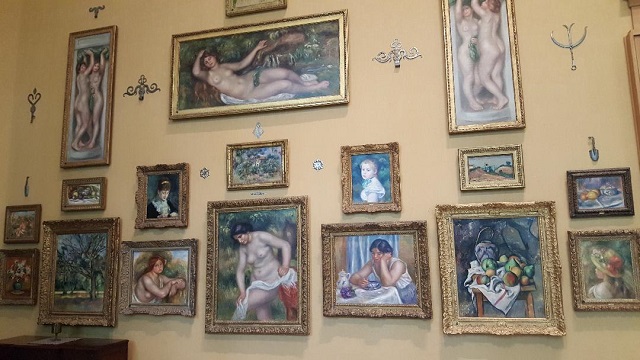
In 2012 Barnes' magnificent collection was moved to beautiful and modern new quarters in Philadelphia, and we drove into the city to see it.  We were told that the rooms and paintings have been arranged just as they were in the original museum.

I'm a big fan of the impressionists and post-impressionists who exploded on the European art scene at the turn of the twentieth century - in particular Pierre-Auguste Renoir but also Paul Cezanne and Paul Gauguin.  The Barnes collection includes 181 paintings by Renoir, 69 by Cezanne, and a few by Gauguin, as well as 46 by Picasso (the earlier and more-to-my-taste Picasso) and others by Van Gogh, Modigliani, Monet, Manet, Degas, Matisse, and many other masters.

It's estimated that Barnes' collection is worth around 25 billion dollars.  And yet the public is allowed to get up close and personal with these treasures.  The paintings are arranged in a series of rooms in what appears to be a casual, haphazard manner, almost as if you were in someone's home, and you can get close, but if you step over that line on the floor just over two feet from the wall, an attendant will shoo you back.


Why do I like Renoir?  Well, there are the nudes ...


... but also look at this study of two young girls.  His work is just so damn pretty.


And not just Renoir.  This is one of the "Card players" series by Cezanne.


Because these are artists I have long admired and because the setting is so welcoming, the Barnes Foundation ranks as my favorite art viewing experience of all time.

Friday, June 1, 2018

The Magnificent Meisenhelders

Nancy was born a Meisenhelder, of the York Meisenhelders.

She grew up in York and Springfield, Pennsylvania.  Her two brothers - Rennie and David - still live in Pennsylvania, and her sister, Julie, lives within driving distance, in Massachusetts.

Once we had set our motorhome up nearby at the Philadelphia/West Chester KOA RV Park, the Meisenhelder clan assembled at a local seafood restaurant.  Here's a photo of Nancy's family at a restaurant later in the week.  From left to right, Julie, Rennie, Rennie's girlfriend Kathy, Nancy, me, and David.


Julie is an artist and graphic designer who is mostly retired.  Rennie is a retired electrician who worked at Franklin Mint.  His birthday on 5/29 is the occasion that brought us all together, and Nancy and I adjusted our travel itinerary to be here this week.  David is a CPA who many years ago helped me build our little castle in Ben Lomond.

Julie recently sent in a specimen of her own to AncestryDNA.com.  Since Nancy, Rennie, and David share the same parents - Ren and Dottie - Julie's results apply for the most part to them as well.  Unfortunately, the Meisenhelder line is not as pure and impressive as I had always thought.  Her ethnicity estimate came back 40% British Isles, 33% Western Europe, and 7% Southern Europe.  Migration data includes Pennsylvania, Ohio, and Indiana settlers typical of German farmer immigrants.  Looks like there's a good dollop of German blood in there, but the Meisenhelders are definitely not pure Aryan.  Thus Nancy is not of the master race.  (I had always assumed that she was).

At the restaurant Julie handed Nancy a canister containing ashes of their dear departed father, Ren.  Julie had divided up his cremains into four equal parts, one to each of the remaining siblings, for disposal as each of them thought best.


We had an excellent meal and a grand time at the restaurant, with plenty of laughs and some not entirely appropriate comments regarding the prior disposal of the remains of other family members.  We have all tried to honor them by selecting disposal sites that reflected their favorite places on Earth.

Later we had a play date for all the Meisenhelder dogs at Rennie's home, where ordinarily his little dog Max is king.  When our Tammy Faye and Sophia and Julie's Bijou invaded his domain, Max began barking obsessively and wore himself out to the point that (according to Nancy) he gave himself a timeout by retreating to a back room to recover.  At some point a wet spot appeared on Rennie's carpet.  Suspicion fell on our Sophia, who was in the area, although only a DNA test would convince me that our perfect little princess was to blame.

This section of the Pennsylvania countryside is very beautiful - rolling hills, incredibly green, lots of big trees, winding country lanes.  There's a variety of housing styles here, with more stone buildings than elsewhere, and with its early American history and its architecture, it reminds me of England, for some reason.  Nancy and I both have a dream of living in a stone house similar to but more modest than the one below, ideally surrounded by beautiful trees and flowers.


It's so pretty that Nancy is relaxing her objection somewhat to living here under the threat of terrible winter weather.  So we drove around looking for that classic small town or city with a downtown full of cool restaurants and shops.  The best example of that we came across was West Chester, which is a very nice community.  We can't rule out this area entirely.